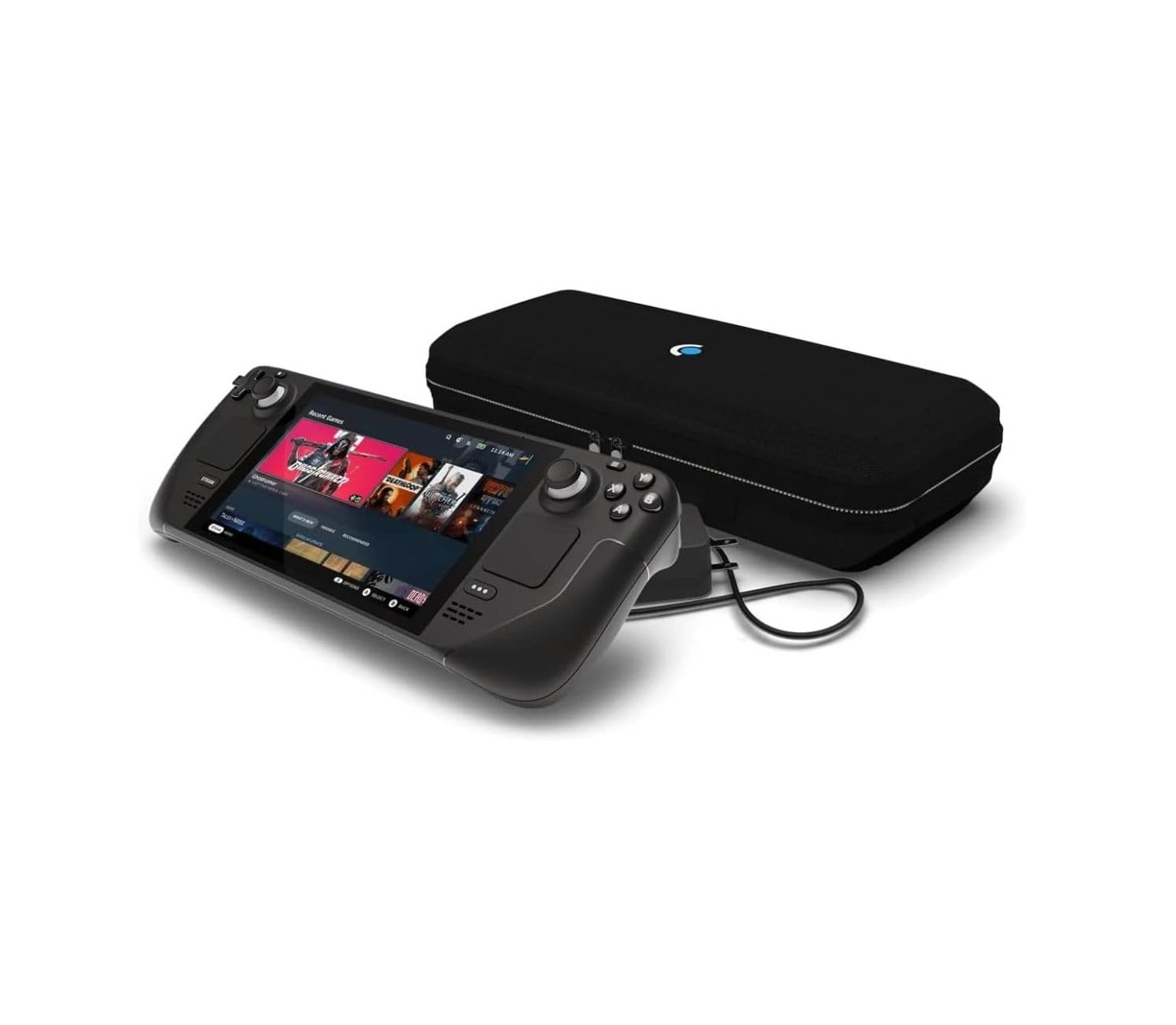
Steam Deck OLED 512GB Review: The Best Steam Deck Yet?
The Valve Steam Deck OLED 512GB is a premium handheld gaming PC featuring a beautiful 7.4-inch HDR OLED display, 90Hz refresh rate, 512GB NVMe SSD, Wi-Fi 6E and improved battery life.
It keeps the same basic gaming architecture as the original Steam Deck while improving almost everything around it — display quality, efficiency, thermals, wireless connectivity and battery life.
Steam Deck OLED 512GB Specs
| Feature | Specification |
|---|---|
| Display | 7.4-inch HDR OLED |
| Resolution | 1280 × 800 |
| Refresh Rate | Up to 90Hz |
| HDR Brightness | Up to 1,000 Nits |
| SDR Brightness | 600 Nits |
| CPU | AMD Zen 2, 4-Core / 8-Thread |
| GPU | 8 RDNA 2 Compute Units |
| GPU Performance | 1.6 TFLOPS |
| RAM | 16GB LPDDR5 |
| Memory Speed | 6400 MT/s |
| Storage | 512GB NVMe SSD |
| Battery | 50Wh |
| Battery Life | Approx. 3–12 Hours |
| Wi-Fi | Wi-Fi 6E |
| Bluetooth | Bluetooth 5.3 |
| Storage Expansion | microSD |
| Weight | Approx. 640g |
| OS | SteamOS 3 |
Valve confirms the OLED model uses a more efficient 6nm AMD APU, while retaining the same Zen 2 CPU and RDNA 2 GPU configuration.
7.4-Inch HDR OLED Display
The display is the biggest upgrade.
The Steam Deck OLED uses a 1280 × 800 HDR OLED panel with:
7.4-inch screen
90Hz refresh rate
1,000-nit HDR peak brightness
600-nit SDR brightness
Over 1,000,000:1 contrast
110% P3 color gamut
Compared with the older 7-inch 60Hz LCD display, the OLED version provides deeper blacks, stronger contrast and noticeably smoother motion.
90Hz Gaming
The higher 90Hz refresh rate is another major improvement over the original 60Hz Steam Deck.
Games capable of running above 60 FPS feel noticeably smoother, while the display can also be configured for lower frame-rate targets to balance performance and battery life.
The touchscreen polling rate was also increased to 180Hz, improving responsiveness.
Gaming Performance
The Steam Deck OLED is faster in some situations, but it is not a major GPU upgrade.
It still uses:
- 4-core / 8-thread Zen 2 CPU
- 8 RDNA 2 Compute Units
- Up to 1.6 TFLOPS GPU performance
- 16GB LPDDR5 RAM
The main hardware change is the move from a 7nm to a more efficient 6nm APU and faster 6400 MT/s memory.
This can improve efficiency and memory latency, but users should not expect a generational jump in frame rates.
512GB NVMe SSD
This model includes a 512GB NVMe SSD.
That is enough for several large games, but modern PC titles can quickly consume storage.
The Steam Deck also includes a high-speed microSD slot, making inexpensive storage expansion simple.
Battery Life
Battery life is significantly improved.
Valve rates the Steam Deck OLED for approximately:
3 to 12 hours of gameplay
depending on the game, brightness and performance settings.
The OLED model uses a larger 50Wh battery, compared with 40Wh in the original LCD model.
Valve says overall battery life can be 30–50% longer than the LCD Steam Deck.
Faster Charging
The battery can charge from approximately 20% to 80% in as little as 45 minutes under suitable conditions.
A 45W USB-C power adapter with a 2.5-meter cable is included.
Wi-Fi 6E
The OLED model upgrades wireless connectivity to tri-band Wi-Fi 6E.
It supports:
- 2.4GHz
- 5GHz
- 6GHz
Valve says downloads can be up to three times faster than on the LCD Steam Deck when used with compatible networking equipment.
This is especially useful for large Steam downloads.
Bluetooth 5.3
Bluetooth is upgraded to Bluetooth 5.3.
Valve also added a dedicated Bluetooth antenna to improve connectivity with controllers and accessories.
Supported Bluetooth audio features include newer codecs such as aptX HD and aptX Low Latency.
SteamOS
The Steam Deck runs SteamOS 3, an Arch Linux-based operating system with a console-style gaming interface.
It gives you direct access to your Steam library while also offering a full KDE Plasma desktop mode.
That makes the Steam Deck far more flexible than a traditional handheld console.
Controls
Steam Deck OLED includes:
- Dual analog sticks
- D-pad
- ABXY buttons
- Analog triggers
- Dual trackpads
- Four programmable rear buttons
- Gyroscope
- HD haptics
The trackpads make mouse-heavy PC games easier to control than on many competing handhelds.
External Displays
The USB-C port supports DisplayPort output.
Valve officially supports external resolutions up to:
4K at 120Hz
8K at 60Hz
However, demanding modern games usually need much lower resolutions for good performance.
Cooling and Weight
Valve redesigned the cooling system with a larger fan and improved thermal hardware.
The OLED model also weighs approximately 640g, around 30g lighter than the older LCD Steam Deck.
That helps slightly during longer handheld gaming sessions.
512GB vs 1TB OLED
The two OLED versions are very similar in performance.
| Feature | 512GB OLED | 1TB OLED |
|---|---|---|
| Storage | 512GB | 1TB |
| Display | 7.4″ OLED | 7.4″ OLED |
| Refresh Rate | 90Hz | 90Hz |
| Anti-Glare Glass | No | Yes |
| Wi-Fi 6E | Yes | Yes |
| Battery | 50Wh | 50Wh |
The 1TB version adds premium anti-glare etched glass and a carrying case with a removable liner.
For users comfortable adding a microSD card, the 512GB model can offer better value.
Steam Deck OLED vs LCD
The OLED model improves almost every quality-of-life feature.
OLED Model: 7.4″ 90Hz HDR OLED, Wi-Fi 6E, 50Wh battery, 6nm APU, ~640g.
LCD Model: 7″ 60Hz IPS LCD, Wi-Fi 5, 40Wh battery, 7nm APU, ~669g.
The performance difference is modest, but the overall handheld experience is significantly better on OLED.
Steam Deck 2?
As of September 2026, Valve has confirmed that a future Steam Deck successor is planned, but it has not announced a launch date. Valve says it wants a meaningful performance-and-efficiency improvement before releasing the next generation.
That means the Steam Deck OLED remains Valve’s current premium handheld.
Pros
✓ Excellent 7.4-inch HDR OLED display
✓ Smooth 90Hz refresh rate
✓ Up to 1,000-nit HDR brightness
✓ Improved 3–12 hour battery life
✓ Fast 512GB NVMe SSD
✓ Wi-Fi 6E
✓ Bluetooth 5.3
✓ Excellent Steam library support
✓ Expandable microSD storage
✓ Excellent controls and trackpads
Cons
✗ Performance is only slightly better than LCD Steam Deck
✗ 800p resolution is relatively low
✗ 512GB fills quickly with large PC games
✗ 512GB version lacks etched anti-glare glass
✗ Large and relatively heavy compared with Nintendo handhelds
✗ Some PC games remain incompatible with SteamOS
Steam Deck OLED 512GB Rating
Display: 9.8/10
Gaming Performance: 8.7/10
Battery: 9.3/10
Controls: 9.7/10
Storage: 8.8/10
Software: 9.5/10
Value: 9.3/10
Overall: 9.3/10
Verdict
The Steam Deck OLED 512GB remains one of the strongest handheld gaming PCs available, especially for users with a large Steam library.
Its biggest improvements are the 7.4-inch HDR OLED display, 90Hz refresh rate, longer battery life, Wi-Fi 6E and improved thermals.
Its biggest limitation is performance: despite the OLED branding and improved efficiency, the CPU and GPU remain very similar to the original Steam Deck.
For users who prioritize screen quality, battery life and SteamOS simplicity, the 512GB OLED model offers an excellent balance between price and features.